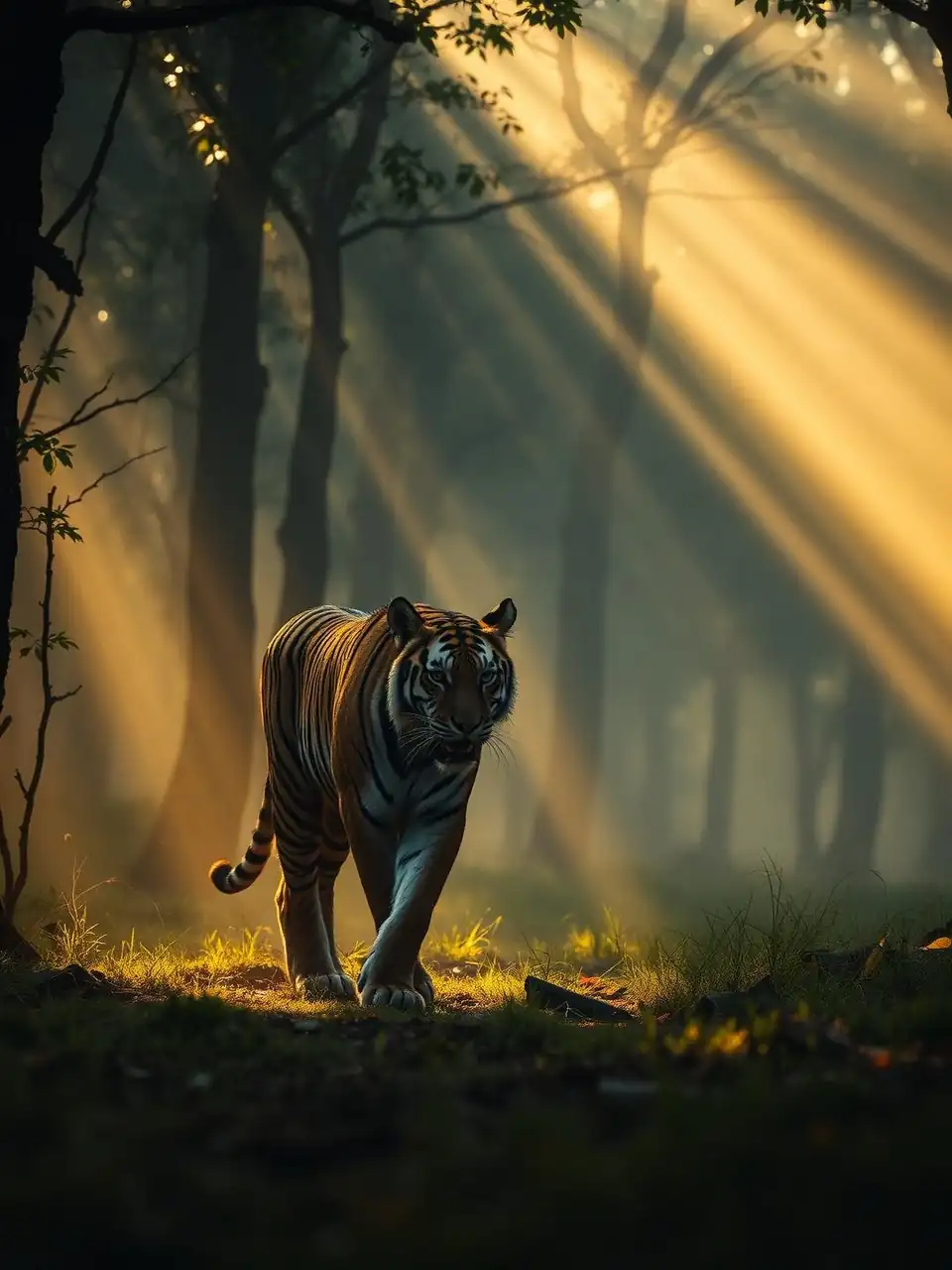
Jim Corbett National Park Safari — India's oldest and greatest tiger reserve.
All 10 safari zones, nine forest rest houses inside the jungle, the full booking process, best season and insider sighting tips — everything you need before you arrive.
Jim Corbett safari booking online — permits, zones and slot timings
Planning Jim Corbett jungle safari booking for the 2026 season? Our desk handles Jim Corbett safari permit booking from start to finish — availability checks, Jim Corbett safari reservation in your chosen slot, open Gypsy jeep and 16-seater canter, and a written confirmation before you travel.
From Jim Corbett safari booking online to confirmed Jim Corbett tiger safari booking, we arrange Jim Corbett jeep safari booking and Jim Corbett canter safari booking across Jim Corbett Dhikala zone safari booking, Jim Corbett Bijrani zone safari booking and Jim Corbett buffer zone safari booking. Jim Corbett safari booking India-wide enquiries are handled by the same team. We arrange Jim Corbett tiger safari 2026 departures as Jim Corbett safari advance booking well ahead of peak dates, and help with Jim Corbett tatkal safari booking when only same-week permits remain. Jim Corbett forest safari booking can be combined with a stay as one of our Jim Corbett safari tour packages — including a Jim Corbett weekend safari package, a relaxed Jim Corbett family safari booking with children, or a multi-vehicle Jim Corbett group safari booking for corporate and photography groups.
Standard safari slot timings
- Morning safari
- 6:00 AM – 11:00 AM
- Evening safari
- 3:00 PM – 6:00 PM
Entry and exit timings shift slightly with sunrise and sunset through the season; your confirmed permit always carries the exact reporting time for the day.
What our Jim Corbett safari booking service covers
TheForestStay is an independent tour operator providing end-to-end safari permit booking, Gypsy arrangement, zone selection, and personalized concierge services across MP Tiger Reserves. Jim Corbett safari booking India-wide enquiries — including Jim Corbett National Park safari booking for travellers arriving from other states or overseas — are handled by the same team on WhatsApp, email or phone.
On this page
Jim Corbett National Park safari at a glance
There is a moment, just before sunrise in the Dhikala grasslands, when the mist has not yet lifted from the Ramganga River and the forest holds its breath. A sambar barks somewhere in the sal trees. Then another. And then, out of the tall grass, a tiger steps onto the track.
This is Jim Corbett National Park — India's first national park, the birthplace of Project Tiger, and home to more tigers than any other reserve on earth. Located in the Himalayan foothills of Uttarakhand, just five hours from Delhi, Corbett is where Indian wildlife conservation began in 1936. Today it holds a staggering 260 tigers, over 1,100 wild elephants, and more than 650 species of birds — the highest avian diversity of any tiger reserve in India.
- Location
- Nainital & Pauri districts, Uttarakhand
- Established
- 1936 (as Hailey National Park)
- Renamed
- 1957, after Jim Corbett
- Project Tiger
- 1973 — India's first tiger reserve
- Total area
- 1,318 sq km (core 520 sq km)
- Tiger population
- 260 — highest in any Indian reserve
- Elephants
- 1,100+ Asiatic elephants
- Bird species
- 650+
- Safari zones
- 10 tourism zones
- Forest rest houses
- 9 — overnight stay inside the forest
- Nearest railway
- Ramnagar Junction (12 km)
- Nearest airport
- Pantnagar (80 km) / Delhi (260 km)
Why Jim Corbett is unlike any other tiger reserve
Corbett holds three records no other Indian reserve can claim: the highest tiger count in a single reserve, one of the highest tiger densities in the world, and the distinction of being India's first national park and first Project Tiger reserve. But the numbers only tell part of the story.
- Elephants alongside tigers — 1,100+ wild elephants, with herds migrating in from Rajaji in summer; fifty or more together is not uncommon
- You can sleep inside the forest — nine Forest Rest Houses, several from the British era, deep within the reserve
- India's finest birding destination — 650+ species including 51 of India's 69 diurnal raptors
- Himalayan setting — the Ramganga River, sal forests, valley grasslands and mountain ridges
- Accessibility — genuine wilderness just 260 km from Delhi
The man behind the name — Jim Corbett's story
James Edward Corbett was born in Nainital in 1875. He began his life in the wild not as a conservationist, but as a hunter. In 1907 he was called to end the reign of the Champawat Tigress, a man-eater credited with 436 human deaths across Nepal and Kumaon — the highest toll attributed to a single animal in recorded history.
Examining her body, Corbett found her canines shattered, likely by a poacher's bullet years earlier. Unable to hunt natural prey, she had turned to humans out of desperation. That single observation reshaped his understanding: tigers are not naturally man-eaters — humans create man-eaters.
Over his lifetime Corbett eliminated 33 man-eating predators responsible for roughly 1,200 deaths, yet increasingly recognised that habitat destruction created them. In 1936 he helped establish Hailey National Park, India's first. His books, Man-Eaters of Kumaon (1944) and The Man-Eating Leopard of Rudraprayag (1947), became global bestsellers and conservation manifestos. In 1957 the park was renamed in his honour.
All safari zones in Jim Corbett — complete zone guide
Corbett is divided into ten tourism zones. Each has its own entry gate, character and wildlife profile. Choosing the right zone is the most important decision in planning your Corbett trip.
Dhikala Zone — the crown jewel
Highest sighting probabilityVast grasslands stretch to the Ramganga Reservoir, framed by Himalayan ridges. This is where tigers, elephants and deer are seen in the greatest numbers and the most spectacular settings.
The critical detail: day jeep safaris are not available in Dhikala. Guides consistently report that guests staying two to three nights at Dhikala Forest Rest House have close to a 100% tiger sighting rate.
- Entry gate
- Dhangarhi Gate · 18 km from Ramnagar
- Season
- 15 November – 15 June
- Day safari
- Canter (16-seater) only
- Jeep safari
- Only for FRH overnight guests
- Famous spots
- High Bank, Crocodile Point, Sambhar Road, Thandi Sarak
- Resident tigers
- Paarwali, Pedwali, Junior Paarwali
Bijrani Zone — best day safari for tiger sightings
Best for day visitorsThe most popular day safari zone and the strongest choice for visitors who cannot secure a Dhikala overnight booking. Open grasslands, sal forest and river streams create excellent visibility, and tiger sightings are consistently frequent.
- Entry gate
- Amdanda Gate · 2 km from Ramnagar
- Season
- 15 October – 30 June
- Safari
- Jeep — morning & evening
- Jeeps per shift
- 30
- Rest houses
- Bijrani FRH, Malani FRH
- Prime areas
- Machaan Chaur, Badhai Chaur, Ringora Chaur
Jhirna Zone — open all year round
Year roundJhirna was a farming village until 1994, when residents were relocated under Project Tiger. The landscape is drier than Dhikala, with scrub vegetation, narrow gorges and Shiwalik terrain. Since 2019 sightings have improved dramatically as the resident tiger population has grown.
- Entry gate
- Dhela Gate · 16 km from Ramnagar
- Season
- Year round, including monsoon
- Safari
- Jeep — morning & evening
- Jeeps per shift
- 30
- Wildlife
- Tiger, leopard, sloth bear, elephant, wild boar
- Best for
- Monsoon visitors, budget travellers
Dhela Zone — birder's choice, year round
Birding · Year roundAdded in 2014, Dhela is rich in birdlife, with open grasslands and mixed sal, rohini, haldu, bahera and kusum forest.
Practical note: Dhela FRH is accessed through Dhela Gate — the same entry point as Jhirna zone. Always confirm your permit clearly states "DHELA" to avoid being routed to the wrong zone.
- Entry gate
- Dhela Gate · 15 km from Ramnagar
- Season
- Year round
- Safari
- Jeep
- Wildlife
- Tiger, leopard, elephant, sloth bear, king cobra
Durga Devi Zone — birdwatching paradise
Rare birds · Hilly terrainOn the north-eastern boundary, Durga Devi is defined by the confluence of the Ramganga and Mandal rivers. The hilly topography creates a habitat unlike any other zone — and it is the finest zone in the park for rare and exotic bird species.
- Entry gate
- Durga Devi Gate · 35 km from Ramnagar
- Season
- 15 November – 15 June
- Safari
- Jeep
- Highlight
- Ramganga + Mandal river confluence
Garjiya Zone — the newest tiger hotspot
Year roundGarjiya (also called Ringora Zone) was carved out of the Bijrani area to address growing demand. Despite being newer, it has quickly earned a reputation for excellent tiger sightings.
- Entry gate
- Ringora Gate
- Season
- Year round
- Safari
- Jeep
- Best for
- Guests staying near Garjiya
Sitabani Zone — walking safari & mythology
Walking safari allowedSitabani is a reserve forest attached to Corbett Tiger Reserve rather than a core zone, which brings two advantages: walking safaris are permitted — one of very few places in any Indian tiger reserve — and the area is believed to be where Sita spent her exile, with ancient temples dotting the forest.
For birders it is arguably Corbett's finest asset: 600+ species recorded, and the stream beds north of Sitabani Temple are where Great Hornbill, Tawny Fish Owl and the rare Ibisbill territories overlap.
- Entry gates
- Tedha, Kota (Bhandarpani), Pawalgarh
- Season
- Year round
- Safari
- Jeep + walking safari
- Jeeps per gate
- 60
Bhandarpani / Kota Zone — newest addition (2024)
Closest to RamnagarOpened by the Ramnagar Forest Division, Kota offers a 26 km track entirely through dense forest. Water bodies created within the zone draw tigers and leopards during summer. Being new, it is far less crowded than Bijrani or Dhikala — ideal for last-minute plans.
- Entry gate
- Bhandarpani Gate · 5 km from Ramnagar
- Safari track
- 26 km through dense forest
- Jeeps per shift
- 30
- Winter timings
- 6:30–10:00 AM · 2:00–5:30 PM
- Summer timings
- 5:30–9:00 AM · 3:00–6:30 PM
- Opened
- May 2024
Hathi Dagar Eco Tourism Zone — elephant's path
Only 15 jeeps per shiftCorbett's newest zone, named "Elephant's Path" for the critical elephant corridor it protects. With only 15 gypsies per shift it is the most exclusive and peaceful safari zone in the park, supporting tigers, leopards, elephants, sloth bears, king cobras and exceptional bird diversity.
- Season
- Year round
- Safari
- Jeep only
- Jeeps per shift
- 15 — most exclusive in Corbett
- Opened
- 7 March 2024
Phato Zone — quiet buffer experience
Offbeat · Year roundA lesser-known buffer zone offering a quieter alternative to the busier core zones, with good general wildlife diversity and year-round access.
- Entry gate
- Phato Gate
- Season
- Year round
- Safari
- Jeep
Zone selection guide — which zone should you book?
| Your priority | Recommended zone |
|---|---|
| Highest tiger sighting chance | Dhikala (overnight FRH stay) |
| Best day safari | Bijrani |
| Visiting during monsoon | Jhirna, Dhela, Hathi Dagar, Garjiya |
| Birdwatching | Sitabani, Durga Devi, Dhela |
| Walking safari | Sitabani |
| Least crowded | Hathi Dagar (only 15 jeeps) |
| Elephant sightings | Dhikala, Hathi Dagar |
| Last-minute booking | Kota / Bhandarpani, Phato |
| Staying at Garjiya resorts | Garjiya Zone |
| Photography | Dhikala, Durga Devi |
Stay inside the forest — complete rest house guide
This is Corbett's greatest and most unique offering. Nine Forest Rest Houses, several built during the British era, allow guests to stay overnight deep inside the tiger reserve. No other major Indian tiger reserve offers this experience.
Dhikala zone rest houses (5)
- Dhikala Main FRH — 32 km from Dhangarhi Gate, 30 rooms and 24 dormitory beds, the best canteen in the park, overlooking the Ramganga Reservoir
- Gairal FRH — 13 km from the gate, directly on the banks of the Ramganga; canteen available
- Sarpduli FRH — 18 km from the gate on the southern bank; high mammal movement and excellent for crocodile sightings
- Sultan FRH — 5 km from Dhangarhi Gate, only two rooms in dense pure sal forest; no canteen, bring your own supplies
- Khinnanauli FRH — 27 km from the gate, the most exclusive and least accessible rest house in the zone
Bijrani zone rest houses (2)
- Bijrani FRH — 9 km from Ramnagar via Amdanda Gate; four double rooms, two singles and one four-bed room, canteen available, solar lamps only
- Malani FRH — 12 km north-west of Bijrani on the core-zone edge, just two double rooms; a favourite among serious birdwatchers, no electricity and scarce water in peak summer
Jhirna & Dhela rest houses (2)
- Jhirna FRH — on the southern boundary along the Ramnagar–Kalagarh road; maximum stay three nights, overnight stays permitted 15 November – 14 June only
- Dhela FRH — four rooms (maximum two per party), maximum stay three nights, attached bathrooms with solar power; guests bring raw food, oil and spices
Forest rest house rules — essential reading
- All rest houses are secured with electric fencing and the surrounding areas are under CCTV surveillance
- Only vegetarian food is permitted; non-vegetarian food and alcohol are strictly prohibited
- Canteens exist only at Dhikala, Gairal, Sarpduli and Bijrani
- At Sultan, Malani, Khinnanauli and Dhela, guests must bring their own raw food, oil and spices
- Electricity is solar-powered — most rest houses have no grid connection
- No cellular network in most locations
- Silence and discipline must be maintained, and all instructions from forest staff and guides followed strictly
Jim Corbett safari booking process — complete guide
All Jim Corbett safari permits are issued through the official Corbett Tiger Reserve portal (eCorbett). TheForestStay handles the entire process for you — permits, gypsy, guide and rest house or resort — so you arrive with everything confirmed in writing.
Advance booking windows
| Visitor type | Booking opens |
|---|---|
| Indian nationals | 45 days before the safari date |
| Foreign nationals | 90 days before the safari date |
New booking slots open every Monday at 10:00 AM. Permits are first-come, first-served and popular zones sell out within hours during peak season.
Step-by-step
- Select your check-in date, zone and safari shift
- Enter the number of adults and children (children below 12 do not need a permit)
- Provide each visitor's name, gender, country, ID type, ID number and age
- Complete payment
- Download and save the e-permit
Documents required
- Indian nationals: Aadhaar Card, Voter ID, Driving Licence or PAN Card
- Foreign nationals: passport (number, name, gender, date of issue and expiry, date of birth, nationality)
- Carry the same original ID submitted during booking — any mismatch means denied entry with no refund
Important booking rules
- All permits are non-refundable and non-transferable
- Permits are valid only for the specific zone and date booked
- Maximum 75 vehicles may enter the park in a single shift
- Maximum 6 adults plus 2 children (under 12) per gypsy
- Mobile phones are banned inside core tourism zones per Supreme Court order
- Vehicles older than 15 years are not permitted
Jim Corbett safari timings — season by season
| Season | Morning safari | Evening safari |
|---|---|---|
| Winter (November – February) | 6:30 AM – 9:30 AM | 2:00 PM – 5:30 PM |
| Summer (March – June) | 5:30 AM – 9:00 AM | 3:00 PM – 6:30 PM |
Timings vary slightly by zone and shift with sunrise and sunset. Morning safaris consistently produce better tiger sightings than evening safaris.
Best time to visit Jim Corbett
Summer (March – June) — best for tiger sightings
As temperatures rise and water sources shrink, tigers concentrate predictably around remaining waterholes and river channels, and thinning vegetation improves visibility. This is unquestionably the best period for tiger photography — and it brings Corbett's greatest spectacle: large elephant herds migrating in from Rajaji Tiger Reserve, with fifty or more animals together.
Winter (November – February) — best overall experience
Comfortable daytime temperatures, clear Himalayan views and migratory birds make winter the most rewarding all-round season. Tiger sightings are less frequent than summer, but the overall experience is exceptional. December is the single best month for birdwatching. Early mornings are genuinely cold and safari vehicles are open-sided — pack warm layers, a beanie, gloves and a neck buff.
Monsoon (July – October) — limited but peaceful
Most core zones close. Jhirna, Dhela, Garjiya, Hathi Dagar, Phato and Sitabani remain open subject to weather. Vegetation is at its densest, making tiger sightings unlikely — but crowds are minimal and the forest is spectacularly green.
Wildlife of Jim Corbett
Big cats and large mammals
Corbett's 260 tigers make it the densest tiger population in a single reserve anywhere. Alongside them roam over 1,100 Asiatic elephants, leopards, sloth bears, Himalayan black bears and yellow-throated martens. Herbivores include sambar, chital, hog deer, barking deer, goral, wild boar, langur and rhesus macaque.
Reptiles
The critically endangered gharial and the mugger crocodile inhabit the Ramganga River and its reservoirs. Corbett also hosts king cobra, Indian rock python, Russell's viper and monitor lizard.
Birds — India's finest tiger reserve for birding
With over 650 recorded species, Corbett holds the highest avian diversity of any Indian tiger reserve, supporting 51 of India's 69 diurnal raptor species and 15 of 26 woodpecker species.
- Star species: Great Hornbill, Pallas's Fish Eagle, Ibisbill, Tawny Fish Owl, Indian Pitta, Wallcreeper, Crested Serpent Eagle
- Critically endangered: White-rumped Vulture, Slender-billed Vulture, Red-headed Vulture, Black-bellied Tern
- Top birding spots: Dhikala Grassland, Ramganga River, Kalagarh Reservoir, stream beds north of Sitabani Temple (no permit required)
Fish
The Ramganga is renowned for the Golden Mahseer, one of the world's great sport fish. Goonch, trout, katla, calbasu and rohu are also present. Angling is permitted only under licence and on a catch-and-release basis.
Attractions near Jim Corbett
- Garjiya Devi Temple — 14 km from Ramnagar, built atop a rock in the Kosi River; a grand fair is held at Kartik Purnima
- Corbett Falls — a 66-foot waterfall in dense forest, 25 km from Ramnagar; excellent picnic and birding spot
- Corbett Museum, Dhangarhi — Jim Corbett's former residence, with artefacts and conservation exhibits
- Kalagarh Dam (Ramganga Dam) — one of Uttarakhand's finest winter birdwatching sites for migratory waterfowl
- Sitabani Forest Reserve — ancient temples in dense forest, open without core-zone permits
- Hanuman Dham — a striking temple 7.5 km from Ramnagar with meditation halls
- Kosi River — along the eastern boundary, ideal for riverside evenings and photography
- Hill stations — Nainital (80 km), Bhimtal (90 km), Sattal (95 km) and Mukteshwar (120 km)
How to reach Jim Corbett
By train (most convenient): Ramnagar Junction is the closest station, just 12 km from the main entry gate, with direct trains from Delhi in approximately 5–6 hours.
| From | Distance | Approx. time by road |
|---|---|---|
| Delhi | 260 km | 5 hours |
| Dehradun | 170 km | 4 hours |
| Nainital | 80 km | 2 hours |
| Lucknow | 430 km | 8 hours |
By air: Pantnagar Airport is nearest at 80 km (2 hours). Delhi's Indira Gandhi International Airport at 260 km offers far greater connectivity and is the practical choice for most travellers.
Essential safari tips — what every visitor should know
Increase your tiger sighting chances
- Visit between March and June — water scarcity concentrates wildlife
- Stay 2–3 nights at Dhikala FRH — sighting rates approach 100%
- Book multiple safaris across different zones — never rely on a single drive
- Choose morning safaris — tigers are most active at dawn
- Maintain complete silence — tigers are extremely noise-sensitive
- Follow your guide's instructions — they read animal behaviour professionally
- Avoid the period immediately after monsoon — vegetation is at its densest
- Be patient — a safari is not a zoo visit
What to wear and carry
- Clothing: neutral earth tones — olive, khaki, brown, beige; avoid white and bright colours. Full sleeves and trousers protect against insects
- Winter additions: beanie, gloves, neck buff and multiple warm layers — safari vehicles offer no shelter
- Equipment: binoculars, camera with 300mm+ telephoto, charged batteries, power bank, reusable water bottle, sunscreen, hat with strap
- Documents: the original ID matching your booking — no exceptions
What is not permitted
- Mobile phones inside core tourism zones (Supreme Court order)
- Food inside safari vehicles — it attracts animals
- Plastic bags and single-use plastic
- Alcohol and non-vegetarian food inside forest rest houses
- Loud music, shouting or vehicle horns
- Alighting from the vehicle at any point
- Feeding or approaching wildlife, and flash photography
Common mistakes to avoid
- Booking accommodation before confirming your safari permit — these are two separate bookings; always confirm the permit first
- Confusing Dhela and Jhirna permits — both zones are accessed through Dhela Gate
- Booking too late — late bookings leave you dependent on local agents charging two to three times official rates
- Not charging camera batteries — Bijrani FRH and most rest houses have no grid electricity
Plan your Jim Corbett safari with TheForestStay
Corbett rewards preparation more than almost any other Indian tiger reserve. The difference between a good trip and an extraordinary one comes down to zone selection, timing and — above all — securing the right accommodation, whether that is a Dhikala forest rest house or a resort positioned close to your chosen gate.
We track which zones are producing sightings this season, understand the forest rest house booking system inside out, and know exactly which resort areas suit which safari plans.
- Zone selection based on your dates, interests and current wildlife activity
- Forest Rest House booking guidance for Dhikala, Bijrani, Jhirna and Dhela
- Resort recommendations across Dhikuli, Garjiya, Kyari, Ramnagar and Patkote
- Complete multi-day itineraries including Corbett, Nainital and Mukteshwar
- Specialist birdwatching itineraries with expert naturalists
- Family, group and corporate wildlife trip coordination
Frequently asked questions — Jim Corbett safari
Which is the best zone for tiger sighting in Jim Corbett?+
Dhikala offers the highest tiger sighting probability, particularly for guests staying overnight at the forest rest houses — guides report sighting rates approaching 100% for two to three night stays. For day visitors, Bijrani is the strongest choice, with consistently frequent tiger sightings and easy access just 2 km from Ramnagar.
How far in advance should I book a Jim Corbett safari?+
Indian nationals can book 45 days in advance; foreign nationals can book 90 days in advance. New slots open every Monday at 10:00 AM on the official Corbett portal. Dhikala forest rest house bookings should be made the moment the window opens, as they sell out within hours.
Can I stay inside Jim Corbett National Park?+
Yes. Corbett has nine Forest Rest Houses across the Dhikala, Bijrani, Jhirna and Dhela zones. This is one of very few Indian tiger reserves offering overnight stays deep inside the forest. Dhikala Main FRH is the most popular, with Gairal, Sarpduli, Sultan, Khinnanauli, Bijrani, Malani, Jhirna and Dhela FRH also available.
Which zones are open during monsoon in Jim Corbett?+
Jhirna, Dhela, Garjiya, Hathi Dagar, Phato and Sitabani remain open year-round, subject to weather and road conditions. Dhikala, Bijrani, Durga Devi and Kota close during the monsoon period.
Why can't I book a jeep safari in Dhikala zone?+
Day jeep safaris are not permitted in Dhikala. Day visitors enter by canter (16-seater open bus). Jeep safaris within Dhikala zone are reserved exclusively for guests staying overnight at one of the zone's forest rest houses.
How many tigers are there in Jim Corbett?+
Jim Corbett holds approximately 260 tigers — the highest number in any single tiger reserve in India and one of the highest tiger densities anywhere in the world.
Are mobile phones allowed in Jim Corbett?+
No. Mobile phone use within core tourism zones of tiger reserves is prohibited in compliance with an order of the Supreme Court of India. Additionally, most forest rest houses have no cellular network coverage.
Is Jim Corbett good for birdwatching?+
Exceptionally so. Corbett hosts over 650 bird species — the highest of any Indian tiger reserve — including 51 of India's 69 diurnal raptors. December is the best month. The stream beds near Sitabani Temple are outstanding and require no core-zone permit.
What is the best time to visit Jim Corbett for tiger sightings?+
March to June offers the highest tiger sighting probability as shrinking water sources concentrate wildlife around waterholes and vegetation thins. This period also coincides with large elephant herd migrations from Rajaji Tiger Reserve.
Which is better — Jim Corbett or Ranthambore?+
Both are outstanding but suit different travellers. Ranthambore offers easier tiger photography thanks to open terrain and named, well-documented tigers. Corbett offers a wilder, more authentic jungle experience with far more tigers, 1,100 elephants, superior birdlife, and the unique opportunity to stay overnight inside the forest.
Ready to plan your wildlife journey?
Share your dates and preferences — our specialists reply within a working day with permits, gypsies and resort options bundled into one clear itinerary.
Offices · Bhopal (HO) · Delhi
Continue exploring
Jim Corbett Resorts
Riverside lodges and resorts near Dhangarhi, Amdanda and Dhela gates.
Read more →Ranthambore Tiger Reserve
Rajasthan's fort-and-lake landscape with the highest sighting rates in India.
Read more →Kanha Tiger Reserve
The sal forests and maidans that inspired The Jungle Book.
Read more →Bandhavgarh safari
India's densest tiger population in the Vindhya hills.
Read more →Pench Tiger Reserve
Teak forests and the Pench river across MP and Maharashtra.
Read more →All tiger reserves
Satpura, Panna, Kuno, Tadoba and every reserve we book.
Read more →