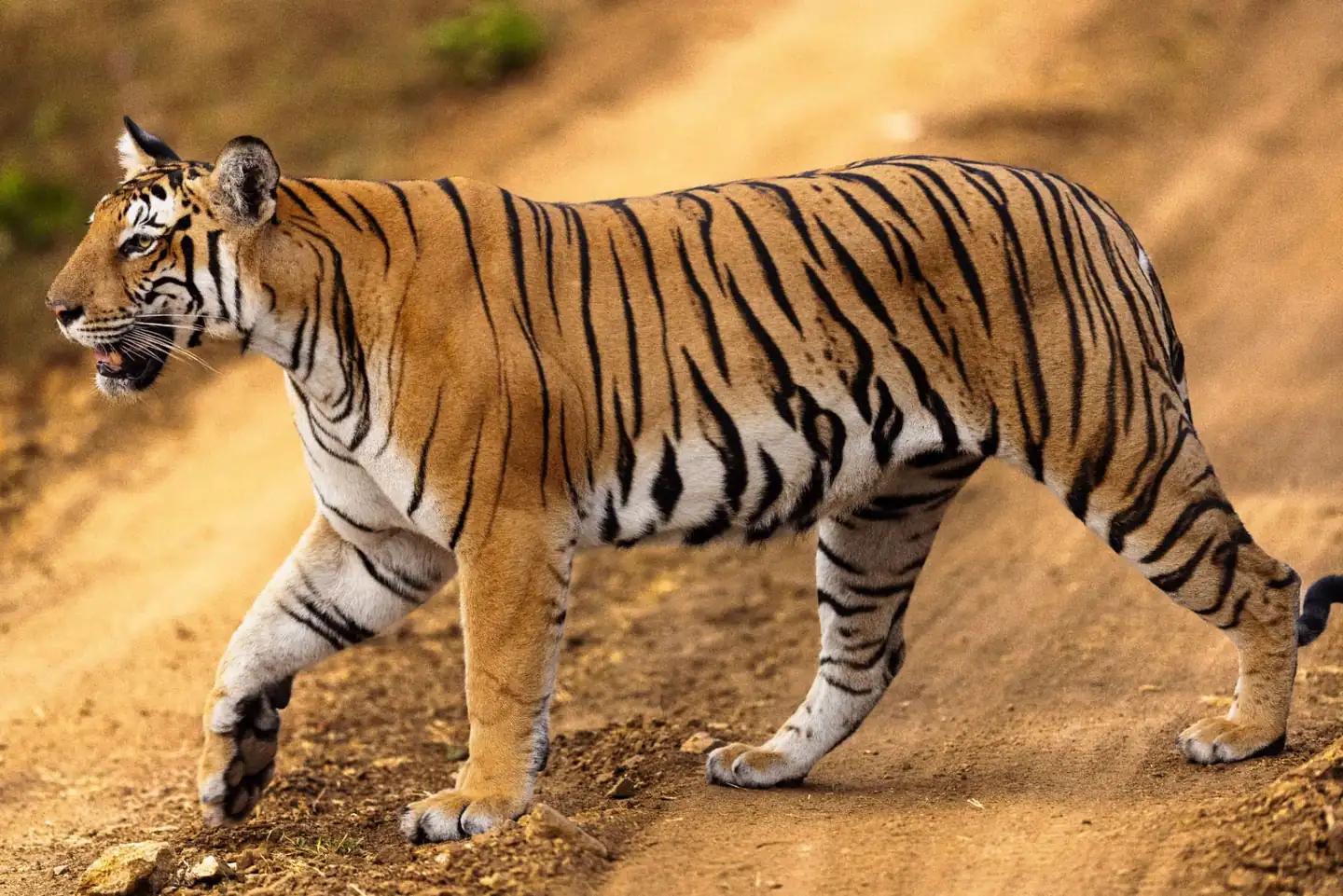
Kanha Safari Booking — Gates, Zones & Jeep Safari
At Kanha you book a gate, and the gate decides which zones you can enter. This guide explains exactly which gate gives which zone, with locations and distances.
Plan your Kanha Safari Booking with complete details on jeep safari zones, the Mukki, Khatia, Kisli and Sarhi gates, permits, timings and travel planning for Kanha National Park and Tiger Reserve.
Kanha Safari Gates & Zones
| Gate/Zone | Best For | Timing |
|---|---|---|
| Mukki Gate | Arrivals from Nagpur or Raipur; Kanha, Kisli and Mukki core zones plus Khapa buffer | Morning and evening safari shifts |
| Khatia Gate | First-time visitors — the only gate reaching all four core zones plus Khatiya buffer | Morning and evening safari shifts |
| Kisli Gate | Kisli core zone drives on the Khatia side of the reserve | Morning and evening safari shifts |
| Sarhi Gate | Quiet Sarhi core zone and Siroja buffer, 70 km from Khatia and Mukki | Morning and evening safari shifts |
Safari shift timings vary by season, and the forest department may revise them. Please confirm the current official timings before you travel.
Safari Permits & Vehicle Arrangements
| Gate/Zone | Notes |
|---|---|
| Mukki Gate | Core zones: Kanha, Kisli, Mukki |
| Khatia Gate | All four core zones plus Khatiya buffer |
| Kisli Gate | Kisli core zone |
| Sarhi Gate | Sarhi core zone and Siroja buffer |
Safari permits and vehicle arrangements depend on availability and applicable booking conditions. Share your travel dates on WhatsApp to receive a written quote before making any payment.
How to Book Kanha Safari Online
- Select your preferred travel dates.
- Choose your preferred gate (Mukki, Khatia, Kisli or Sarhi), subject to availability.
- Share required visitor details and identification information.
- Check available safari options.
- Complete the booking/payment process as instructed.
- Receive booking confirmation according to the existing booking process.
Best Time to Book
Weekends, public holidays and peak season dates often have limited permit availability, so booking well in advance is recommended.
Kanha safari booking online — permits, zones and slot timings
Planning Kanha jungle safari booking for the 2026 season? Our desk handles Kanha safari permit booking from start to finish — availability checks, Kanha safari reservation in your chosen slot, Kanha jeep safari booking and shared Kanha canter safari booking where the gate allows it, and a written confirmation before you travel.
Kanha tiger reserve safari booking is gate-led: Kanha core zone safari booking (Kanha, Kisli, Mukki, Sarhi) and Kanha buffer zone safari booking (Khatiya, Khapa, Siroja) both depend on the gate you enter through, so we confirm that pairing in writing before anything is paid. We arrange Kanha tiger safari 2026 departures as Kanha safari advance booking well ahead of peak dates, and help with Kanha tatkal safari booking when only same-week permits remain. Kanha forest safari booking can be combined with a stay as one of our Kanha safari tour packages — including a Kanha weekend safari package, a relaxed Kanha family safari booking with children, or a multi-vehicle Kanha group safari booking for corporate and photography groups.
Standard safari slot timings
- Morning safari
- 6:00 AM – 11:00 AM
- Evening safari
- 3:00 PM – 6:00 PM
Entry and exit timings shift slightly with sunrise and sunset through the season; your confirmed permit always carries the exact reporting time for the day.
What our Kanha safari booking service covers
TheForestStay is an independent tour operator providing end-to-end safari permit booking, Gypsy arrangement, zone selection, and personalized concierge services across MP Tiger Reserves. Kanha safari booking India-wide enquiries — including Kanha Tiger Reserve safari booking for travellers arriving from other states or overseas — are handled by the same team on WhatsApp, email or phone.
Kanha at a glance — key facts
Kanha is widely regarded as the finest tiger reserve in Asia, and the reason becomes obvious within minutes of entering. Vast open meadows — the famous maidans — stretch between dense sal forest, creating sightlines that few Indian reserves can match. Herds of barasingha graze in the open. And somewhere in the treeline, a tiger is watching.
But Kanha has a booking system that confuses almost everyone. Unlike most reserves where you book a zone, at Kanha you book a gate — and the gate determines which zones you can access. Get this wrong and you will find yourself unable to visit the zone you travelled for.
- Location
- Mandla & Balaghat districts, Madhya Pradesh
- National park
- 1955
- Tiger reserve
- 1973 — one of India's first nine
- Core area
- ~940 sq km
- Total with buffer
- ~1,945 sq km
- Core zones
- Kanha, Kisli, Mukki, Sarhi
- Buffer zones
- Khatiya, Khapa, Siroja
- Safari gates
- Khatiya, Mukki, Sarhi
- Open season
- 1 October – 30 June
- Icon species
- Hard-ground barasingha
- Nearest airport
- Jabalpur (~160 km)
- Booking
- forest.mponline.gov.in
Why Kanha
Considered Asia's finest tiger reserve. This is not marketing language — Kanha's management, habitat quality and prey density have earned that reputation across decades of conservation literature.
The open maidans. Kanha's grassland meadows are its signature. Unlike the dense forest of Corbett or the ravines of Satpura, Kanha offers wide open sightlines where a tiger crossing a meadow can be watched for minutes rather than seconds.
The barasingha success story. The hard-ground barasingha — a swamp deer subspecies found nowhere else on earth — was down to around sixty-six animals in the 1970s. Kanha's conservation programme brought it back from the brink.
Genuine Jungle Book country. Kanha, alongside Pench, is associated with the forests that inspired Kipling. The sal forests and meadows here match his descriptions closely.
Excellent infrastructure. As one of India's original nine Project Tiger reserves, Kanha has decades of established safari management, well-trained guides and reliable systems.
Understanding Kanha's gate system — read this first
At Kanha, safari access is determined by your entry gate, not by the zone name. Each gate opens into a specific set of core and buffer zones. You cannot enter through one gate and drive into a zone that gate does not serve.
| Gate | Core zones accessible | Buffer zone |
|---|---|---|
| Khatiya | Kanha, Kisli, Mukki, Sarhi — all four | Khatiya Buffer |
| Mukki | Kanha, Kisli, Mukki | Khapa Buffer |
| Sarhi | Sarhi only | Siroja Buffer |
- Khatiya is the only gate offering all four core zones — for first-time visitors this makes it the safest choice.
- Mukki gate cannot access Sarhi Core. This catches people out regularly.
- Sarhi gate accesses only Sarhi Core and Siroja Buffer — nothing else, and it is 70 km from the other two gates.
Always confirm which gate your accommodation is closest to before booking a safari.
Safari gates and zone access — complete guide
Three gates, four core zones and three buffer zones. Here is exactly what each entry point gives you, with map locations.
Khatiya Gate — the main entry
Khatiya is Kanha's primary and most important gate. It is the only entry point offering access to all four core zones — Kanha, Kisli, Mukki and Sarhi — plus the Khatiya buffer. Most of Kanha's accommodation clusters around Khatiya, and for a first visit it is the sensible default.
- Core zones
- Kanha, Kisli, Mukki, Sarhi — all four
- Buffer zone
- Khatiya Buffer
- Role
- Main entry point
- From Jabalpur
- ~160 km
- Best for
- First-time visitors, maximum zone flexibility
Khatiya Buffer Zone
The Khatiya buffer departs from the same gate and is a genuinely good alternative when core permits are unavailable. Buffer safaris see fewer vehicles and produce solid sightings — particularly leopard, sloth bear and excellent birdlife.
- Type
- Buffer
- Departs from
- Khatiya gate
- Best for
- Short-notice bookings, uncrowded drives
Mukki Gate — the eastern entry
Mukki gate sits on the eastern side of the reserve and serves the Mukki-side resorts. It accesses three of Kanha's four core zones along with the Khapa buffer. The Mukki side is quieter than Khatiya, with fewer resorts and a more secluded feel — many experienced Kanha visitors prefer it for exactly this reason. Critical limitation: Mukki gate does not provide access to Sarhi Core.
- Core zones
- Kanha, Kisli, Mukki
- Not accessible
- Sarhi Core
- Buffer zone
- Khapa Buffer
- From Sarhi gate
- 70 km
- Best for
- Quieter experience, Mukki-side accommodation
Khapa Buffer Zone
Khapa buffer is accessed from the Mukki gate area. Like all Kanha buffers it offers lower vehicle density and reliable general wildlife sightings.
- Type
- Buffer
- Departs from
- Mukki gate area
- Best for
- Mukki-side stays, flexible booking
Sarhi Gate — the specialist entry
Sarhi is Kanha's most restricted gate. It accesses Sarhi Core and Siroja Buffer only — no other zone is available from this entry point. It is also 70 km from both Khatiya and Mukki, so it is not a gate you can casually add to a Khatiya-based itinerary. What Sarhi offers in return is solitude: it sees the fewest vehicles of any Kanha gate.
- Core zone
- Sarhi only
- Buffer zone
- Siroja Buffer
- From Khatiya gate
- 70 km
- From Mukki gate
- 70 km
- From Jabalpur
- 142 km
- From Raipur
- 223 km
- Best for
- Repeat visitors, solitude, uncrowded safaris
Siroja Buffer Zone
Siroja buffer is accessed from Sarhi gate and is among the least-visited safari areas in Kanha. Genuinely peaceful forest with good general wildlife.
- Type
- Buffer
- Departs from
- Sarhi gate
- Best for
- Maximum solitude
Complete gate and zone reference table
| Gate | Zone accessible | Type | Key distance | Location |
|---|---|---|---|---|
| Khatiya | Kanha Core | Core | Main entry | View location |
| Khatiya | Kisli Core | Core | Main entry | View location |
| Khatiya | Mukki Core | Core | Main entry | View location |
| Khatiya | Sarhi Core | Core | Main entry | View location |
| Khatiya | Khatiya Buffer | Buffer | Main entry | View location |
| Mukki | Kanha Core | Core | Eastern side | View location |
| Mukki | Kisli Core | Core | Eastern side | View location |
| Mukki | Mukki Core | Core | Eastern side | View location |
| Mukki | Khapa Buffer | Buffer | Eastern side | View location |
| Sarhi | Sarhi Core | Core | 70 km from Khatiya | View location |
| Sarhi | Siroja Buffer | Buffer | 70 km from Khatiya | View location |
Which gate should you book?
| Staying at | Book this gate |
|---|---|
| Khatiya / Kisli area resorts | Khatiya Gate |
| Mukki side resorts | Mukki Gate |
| Sarhi area | Sarhi Gate |
| Arriving from Jabalpur | Khatiya (most resorts) or Sarhi (142 km) |
| Arriving from Raipur | Sarhi (223 km) or Mukki side |
| Your priority | Recommended gate |
|---|---|
| First visit, maximum flexibility | Khatiya — all four core zones |
| Quieter experience | Mukki |
| Maximum solitude | Sarhi |
| Specifically want Sarhi Core | Khatiya or Sarhi (never Mukki) |
| Buffer safari, easy booking | Khatiya Buffer or Khapa Buffer |
| Barasingha viewing | Khatiya — Kanha and Kisli meadows |
The Forest Stay recommendation: for a first Kanha visit, stay near Khatiya and book Khatiya gate. It is the only entry offering all four core zones, so if one zone's permits are unavailable you still have three alternatives from the same gate. No other gate gives you that flexibility.
Common Kanha Safari Booking Mistakes (And How to Avoid Them)
Mistake: Booking Mukki gate hoping to visit Sarhi zone
Why it fails: Mukki gate does not connect to Sarhi Core — you'll be denied entry to that zone.
Correct approach: If Sarhi is your priority, book through Khatiya or Sarhi gate only.
Mistake: Choosing a resort before confirming your gate
Why it fails: A resort near Khatiya is 70 km from Sarhi gate — you could end up with a 2+ hour transfer every safari morning.
Correct approach: Confirm your zone and gate first, then choose a resort within easy reach of that specific entry point.
Mistake: Booking safari permits less than a week before travel
Why it fails: Popular zones during peak season (November-February) often sell out weeks in advance.
Correct approach: Book at least 15-20 days ahead for weekend dates, especially during winter months.
Mistake: Assuming all gates offer the same wildlife experience
Why it fails: Sarhi's remote location means different sighting patterns and far fewer vehicles than Khatiya.
Correct approach: Decide whether you want maximum flexibility (Khatiya) or a quieter experience (Sarhi) before booking.
Safari booking process
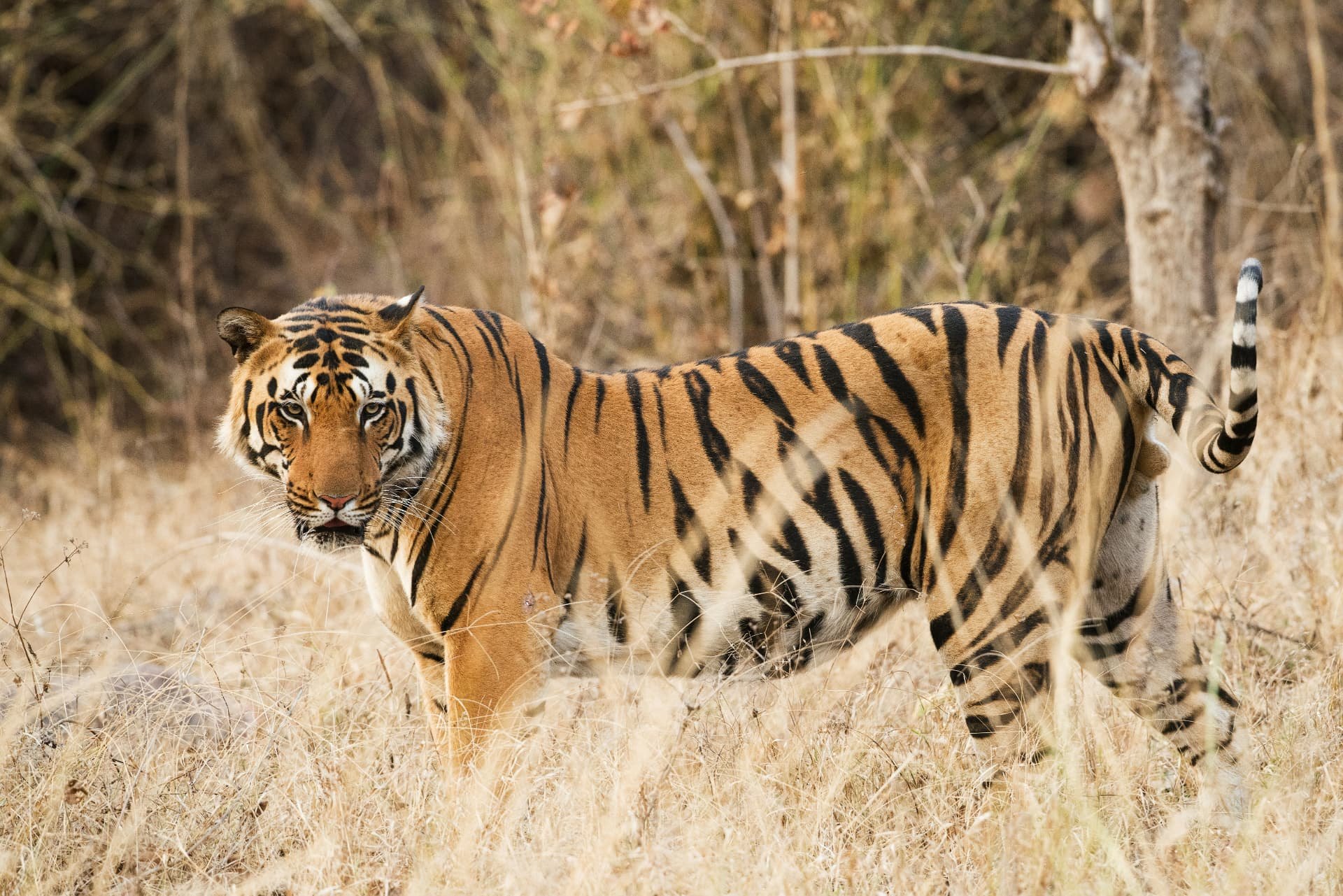
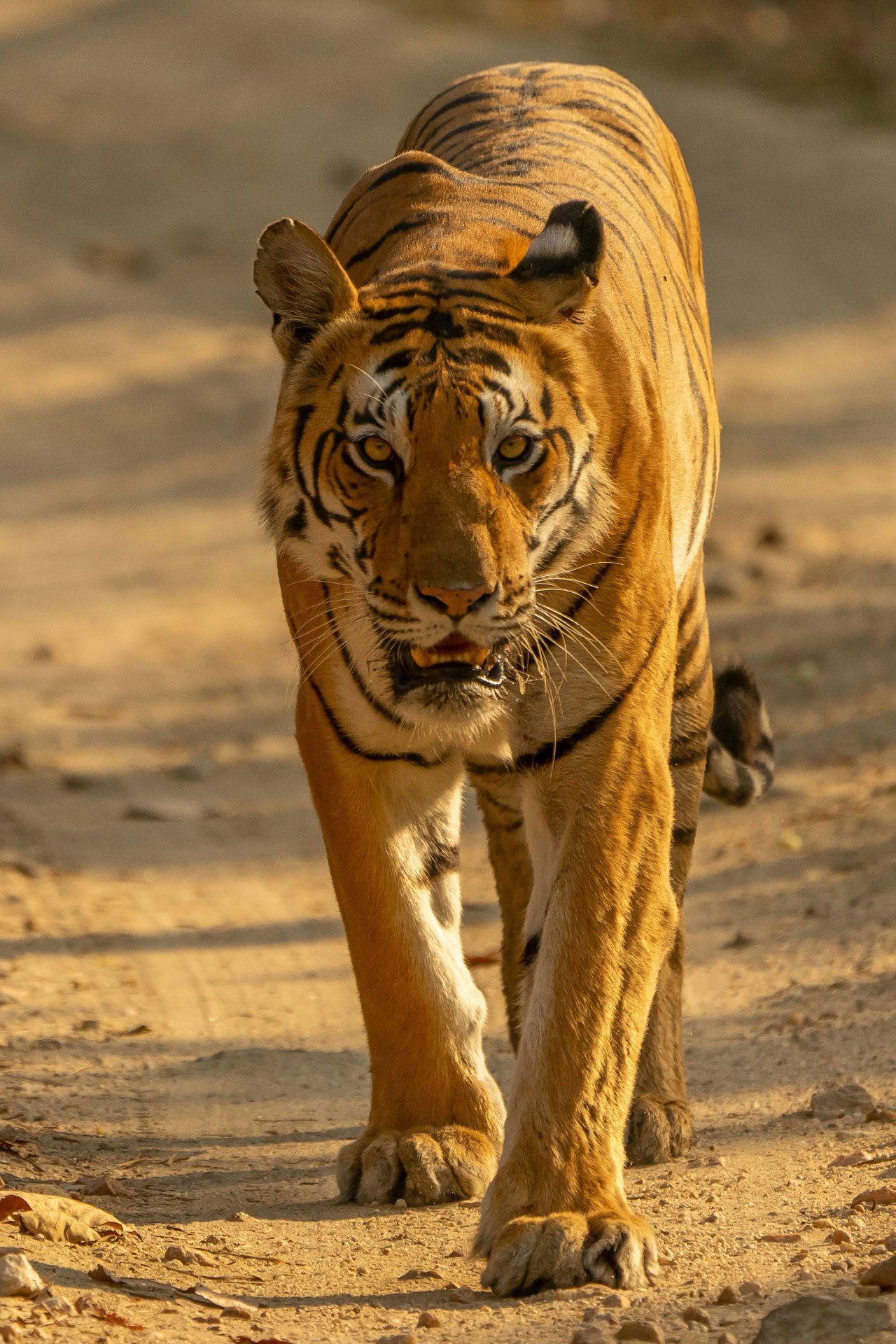
Official booking portal
Kanha safari permits are booked through the Madhya Pradesh Forest Department's official system at forest.mponline.gov.in, which covers Kanha alongside all other MP tiger reserves.
How Kanha booking works
When booking you select a gate and zone combination — not simply a zone. The system will only offer zones available from your chosen gate. Core zone permits at Khatiya fill quickly during peak season, particularly November through February and again in April and May. Buffer permits — Khatiya, Khapa, Siroja — generally retain availability closer to travel dates and offer genuine value.
Documents required
Original photo identification is mandatory for every visitor. Indian nationals may present Aadhaar, Voter ID, PAN Card or Driving Licence; foreign nationals must carry a passport. The same ID used at booking must be carried during the safari — forest officials may verify at any point.
Timings and season
Kanha is open from 1 October to 30 June and closes for the monsoon from July to September. Two safaris operate daily, with timings shifting seasonally in line with sunrise and sunset. Vehicles and guides are allocated by the forest department and are not selectable.
The barasingha — Kanha's conservation triumph
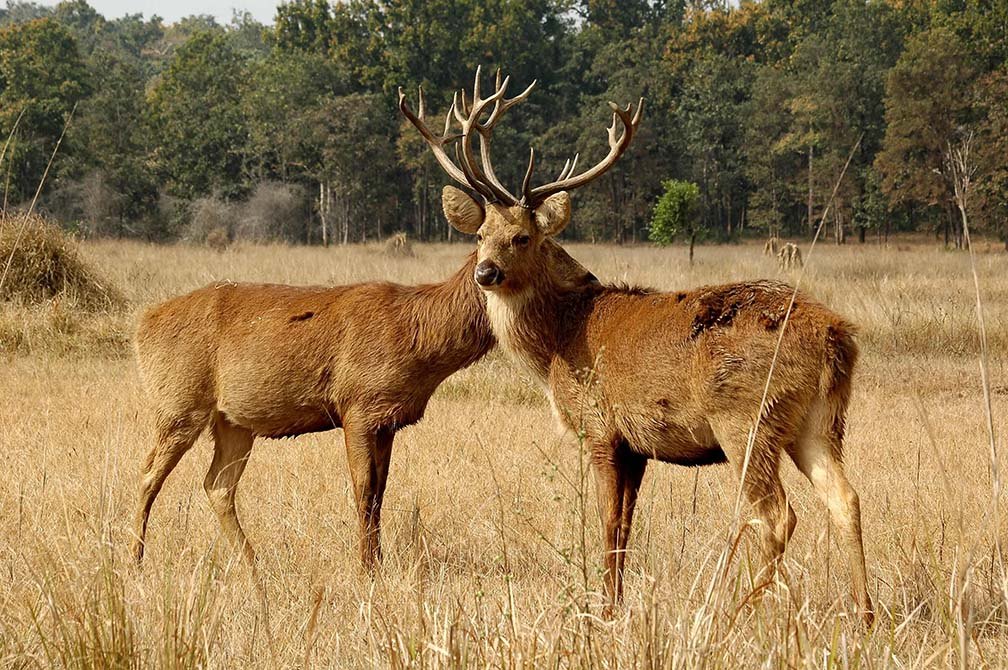
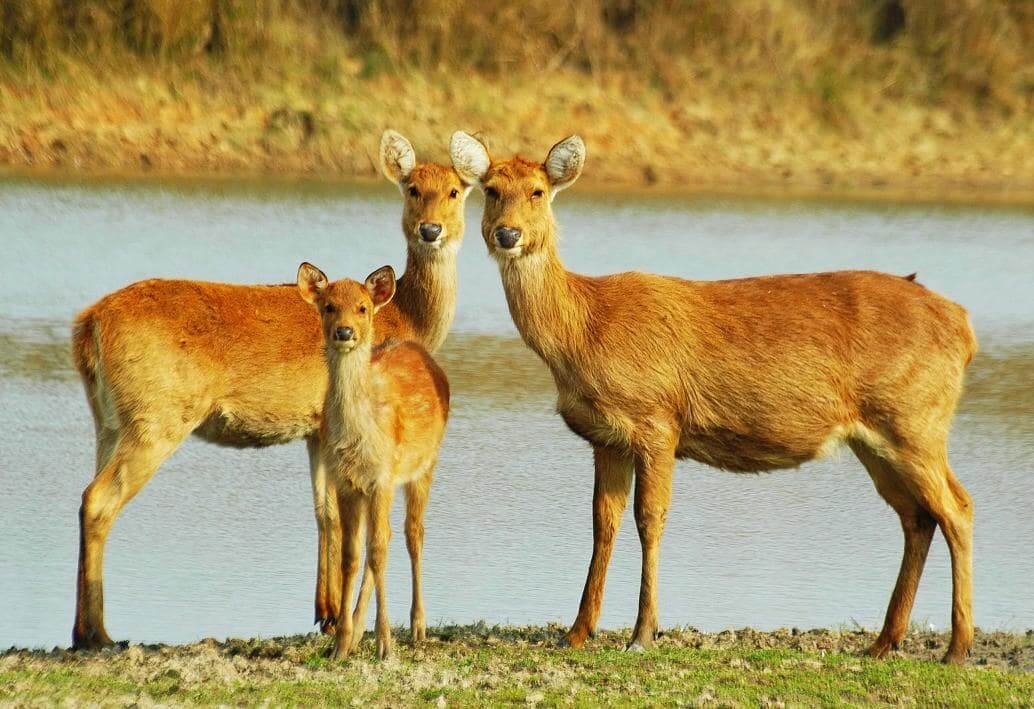
The hard-ground barasingha (Rucervus duvaucelii branderi) is a subspecies of swamp deer that exists nowhere else on earth except Kanha. Unlike other swamp deer that inhabit wetlands, this population adapted to the hard grassland of Kanha's meadows.
By the early 1970s the population had crashed to approximately sixty-six animals. Kanha's management responded with one of the most focused conservation programmes in Indian history — habitat management, meadow restoration, predator monitoring and eventually enclosure breeding.
Today barasingha graze across Kanha's meadows in healthy herds, and animals have since been translocated to other reserves to establish additional populations. The barasingha you watch in Kanha's maidans exist because of deliberate, sustained conservation work.
Wildlife of Kanha
Predators
- Bengal tiger — one of India's most significant populations, well-habituated to vehicles
- Indian leopard — frequently sighted, particularly in buffer zones
- Dhole (Indian wild dog) — Kanha is excellent for pack sightings
- Sloth bear, jungle cat, golden jackal and striped hyena
Herbivores
- Hard-ground barasingha — found nowhere else on earth
- Gaur (Indian bison) — large herds, spectacular in summer
- Sambar, chital, barking deer and nilgai
- Four-horned antelope (chausingha)
- Wild boar, common langur and rhesus macaque
Birds — 300+ species
Kanha's combination of sal forest, bamboo and open meadow supports exceptional birdlife. Indian roller, crested serpent eagle, Malabar pied hornbill, Indian pitta, paradise flycatcher and numerous woodpeckers and raptors are regularly recorded. Winter brings migratory species to the reserve's water bodies.
Reptiles
Indian rock python, monitor lizard, marsh crocodile in water bodies, and a range of snake species.
The landscape — Kanha's famous maidans
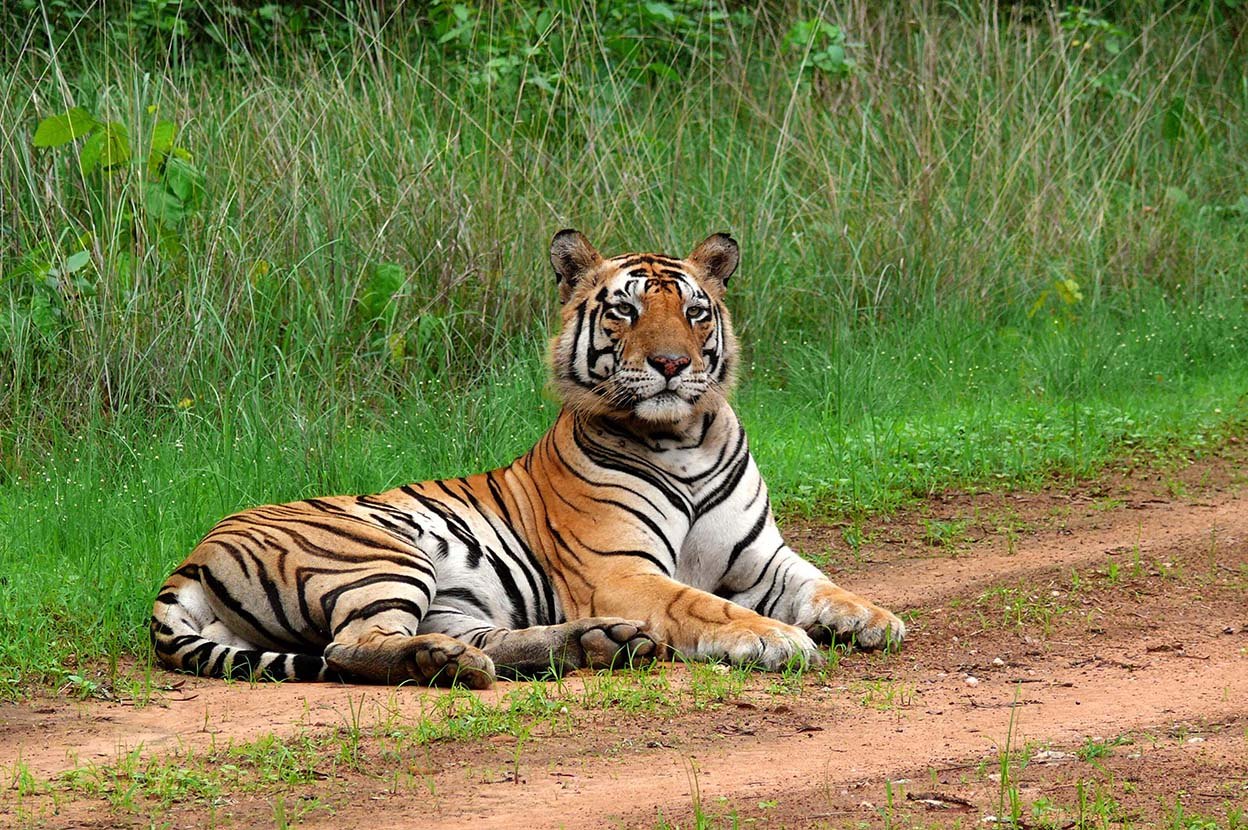
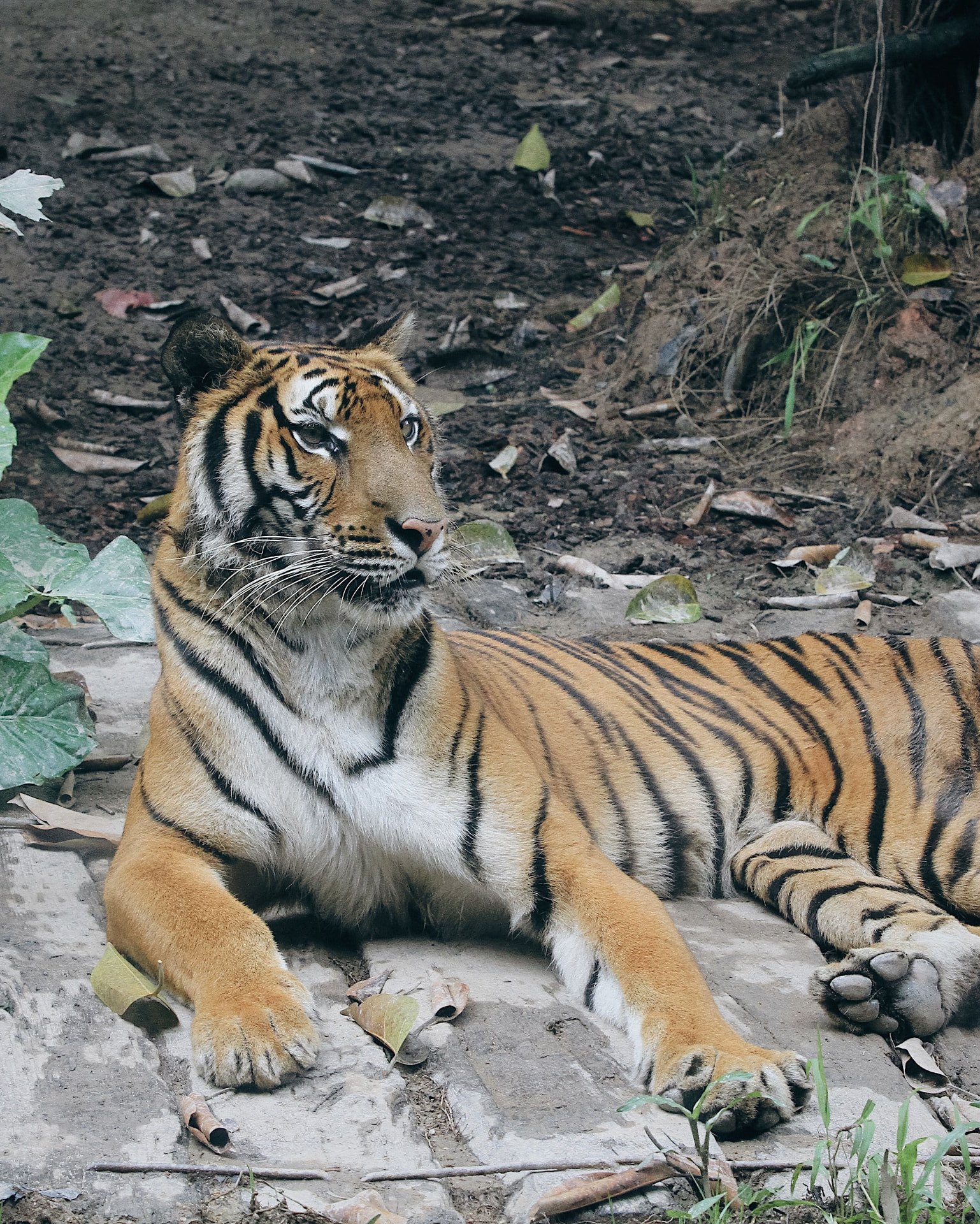
Kanha's defining feature is its grassland meadows, known locally as maidans. These open expanses — formed where villages were relocated during the reserve's establishment — create the sightlines that make Kanha exceptional for wildlife viewing. Herds of chital, barasingha and gaur graze in the open, and predators must cross these spaces to hunt.
Surrounding the meadows is dense sal forest, with bamboo thickets, streams and low hills creating habitat variety. The Banjar and Halon rivers flow through the landscape.
The Bamni Dadar viewpoint, often called Sunset Point, offers one of the finest panoramas of any Indian tiger reserve and is a standard inclusion on Kanha and Kisli zone safaris.
How to reach Kanha
By air
Jabalpur Airport is the nearest at approximately 160 km from the Khatiya side and 142 km from Sarhi, with connections to Delhi, Mumbai, Hyderabad and Bengaluru. Nagpur and Raipur airports are alternatives, particularly for the Mukki or Sarhi sides.
By train
Jabalpur Junction is the most convenient railhead. Gondia and Balaghat stations serve the Mukki side, and Raipur is practical for approaches from Chhattisgarh.
By road
| From | To Kanha |
|---|---|
| Jabalpur | ~160 km (Khatiya), 142 km (Sarhi) |
| Raipur | 223 km (Sarhi) |
| Nagpur | ~270 km |
| Pench | ~200 km |
| Bandhavgarh | ~250 km |
| Inter-gate route | Distance |
|---|---|
| Khatiya to Sarhi | 70 km |
| Mukki to Sarhi | 70 km |
Where to stay
- Khatiya / Kisli area — the most developed accommodation cluster, from budget lodges to premium jungle resorts. Best for Khatiya gate access and therefore all four core zones.
- Mukki side — quieter, with fewer but often higher-quality properties. Ideal for Mukki gate and Khapa buffer safaris.
- Sarhi area — limited accommodation, suited to visitors specifically targeting Sarhi Core and Siroja Buffer.
The critical rule: match your accommodation to your gate. Sarhi is 70 km from both Khatiya and Mukki — staying on one side with a permit for the other means a long pre-dawn drive.
Best time to visit Kanha
November to February — best overall
Cool, comfortable temperatures and excellent conditions across both safari shifts. Winter migrants arrive and the meadows are at their most photogenic with morning mist. This is peak season — book well ahead.
March to June — best for tiger sightings
As central Indian summer intensifies, water sources shrink and animals concentrate predictably. Vegetation thins and Kanha's already excellent sightlines become exceptional. Gaur herds are particularly impressive. Temperatures are severe but morning safaris remain highly productive.
October — post-monsoon
The reserve reopens into spectacular greenery. Sightings are less predictable with abundant water and dense grass, but crowds are lower and the landscape is at its most beautiful.
July to September — closed
Kanha closes for the monsoon.
Combining Kanha with other destinations
- Kanha + Bandhavgarh (6N/7D) — approximately 250 km apart, the classic Madhya Pradesh tiger circuit combining Kanha's meadows with Bandhavgarh's high tiger density.
- Kanha + Pench (5N/6D) — around 200 km apart. Both are Jungle Book country, and the contrast between Kanha's maidans and Pench's teak forest is genuinely interesting.
- Kanha + Satpura (6N/7D) — pair Kanha's classic safari experience with Satpura's walking and boat safaris.
- Central India Grand Circuit (10N/11D) — Kanha, Bandhavgarh, Pench and Satpura, the four finest reserves in Madhya Pradesh.
Essential visitor guidelines
Rules
- Carry original photo ID matching your booking on every safari
- Confirm your gate serves the zone you want before booking
- Maintain silence throughout the drive
- Never alight from the vehicle
- No feeding or approaching wildlife
- Carry all waste out of the reserve
- Guides and vehicles are allocated by the department — not selectable
What to carry
- Original identification for all passengers
- Neutral clothing — olive, khaki, brown, beige
- Warm layers for winter mornings; Kanha mornings are genuinely cold
- Binoculars — essential for barasingha and birdlife across the meadows
- Camera with telephoto lens
- Water and sun protection for summer
- Fully charged batteries and a power bank
Frequently asked questions — Kanha safari
Which gate is best for Kanha Tiger Reserve?+
Khatiya gate is the best choice for most visitors because it is the only gate offering access to all four core zones — Kanha, Kisli, Mukki and Sarhi — plus the Khatiya buffer. This gives maximum flexibility if permits for a particular zone are unavailable.
How does the Kanha gate and zone system work?+
At Kanha, your entry gate determines which zones you can visit. Khatiya gate accesses all four core zones plus Khatiya Buffer. Mukki gate accesses Kanha, Kisli and Mukki cores plus Khapa Buffer. Sarhi gate accesses only Sarhi Core and Siroja Buffer.
Can I visit Sarhi Core from Mukki gate?+
No. This is the most common misunderstanding at Kanha. Mukki gate does not provide access to Sarhi Core. To visit Sarhi Core you must enter through either Khatiya gate or Sarhi gate.
How far is Sarhi gate from Khatiya and Mukki?+
Sarhi gate is 70 km from both Khatiya and Mukki gates. It is also 142 km from Jabalpur and 223 km from Raipur. Because of this distance, Sarhi is not practical to combine with a Khatiya or Mukki-based stay.
Which zones does Khatiya gate cover?+
Khatiya gate provides access to all four core zones — Kanha Core, Kisli Core, Mukki Core and Sarhi Core — along with the Khatiya Buffer Zone. It is the only Kanha gate offering complete core zone access.
What are Kanha's buffer zones?+
Kanha has three buffer zones. Khatiya Buffer is accessed from Khatiya gate, Khapa Buffer from Mukki gate, and Siroja Buffer from Sarhi gate. Buffer safaris see fewer vehicles, retain availability closer to travel dates, and offer good sightings.
What is the barasingha and why is Kanha famous for it?+
The hard-ground barasingha is a swamp deer subspecies found nowhere else on earth. Its population had fallen to roughly sixty-six animals by the early 1970s. Kanha's conservation programme brought the subspecies back from near extinction, and today healthy herds graze across the reserve's meadows.
How do I book a Kanha safari?+
Kanha safari permits are booked through the Madhya Pradesh Forest Department portal at forest.mponline.gov.in. You select a gate and zone combination — the system will only offer zones available from your chosen gate.
How far is Kanha from Jabalpur?+
Jabalpur is approximately 160 km from the Khatiya side and 142 km from Sarhi gate. Jabalpur is the nearest airport and the most convenient railhead for most Kanha visitors.
When is Kanha Tiger Reserve open?+
Kanha is open from 1 October to 30 June, closing during the monsoon from July to September. Additional seasonal or festival closures are set annually by the MP Forest Department.
Are Kanha buffer zones worth booking?+
Yes. Khatiya, Khapa and Siroja buffers see considerably fewer vehicles than the core zones and produce reliable sightings of leopard, sloth bear, dhole and excellent birdlife. They also retain availability when core permits are sold out.
Is Kanha or Bandhavgarh better?+
They offer different experiences. Bandhavgarh has higher tiger density and better sighting probability in a more compact area. Kanha has vastly better landscape with its open meadows, the unique hard-ground barasingha, and a more spacious, less crowded feel. Many visitors combine both — they are around 250 km apart.
How far in advance should I book a Kanha safari?+
For peak season (November to February) and weekend dates, book at least 15-20 days in advance. For weekdays or the summer months (March-June), 7-10 days is usually sufficient, though popular gates can still sell out.
What happens if my chosen zone's permits are sold out?+
If you've booked through Khatiya gate, you have flexibility across all four core zones, so an alternative zone is usually available. Mukki and Sarhi gate visitors have fewer alternatives since each connects to a smaller set of zones.
Is a morning or evening safari better at Kanha?+
Morning safaris (6:00 AM – 11:00 AM) generally offer cooler temperatures and higher overall wildlife activity. Evening safaris (3:00 PM – 6:00 PM) can offer excellent lighting for photography. Many visitors do both across a 2-day visit for the best chance of sightings.
Can I change my gate after booking?+
Zone and gate changes depend on permit availability for your new choice and are not always possible close to your travel date. It's best to confirm your gate choice carefully before booking.
Kanha's gate-and-zone system creates more booking confusion than any other Indian tiger reserve. At The Forest Stay we match your gate to your accommodation, ensure your permit covers the zones you actually want, and structure itineraries that make sense geographically.
Read our complete Kanha Tiger Reserve Guide for travel planning detail, or Compare Kanha Gates & Zones in Detail before you pick an entry point.
Ready to plan your wildlife journey?
Share your dates and preferences — our specialists reply within a working day with permits, gypsies and resort options bundled into one clear itinerary.
Offices · Bhopal (HO) · Delhi
Continue exploring
Kanha Gates & Zones Guide
Interactive gate map — which core and buffer zones Khatiya, Mukki and Sarhi open.
Read more →Bandhavgarh Tiger Reserve
~250 km away — India's highest tiger density, the classic MP pairing with Kanha.
Read more →Pench Tiger Reserve
~200 km away — Jungle Book country across MP and Maharashtra, 10 safari gates.
Read more →Kanha Resorts
Khatiya, Kisli, Mukki and Sarhi side lodges and jungle resorts.
Read more →All Tiger Reserves
Kanha, Bandhavgarh, Pench, Satpura, Panna and more.
Read more →