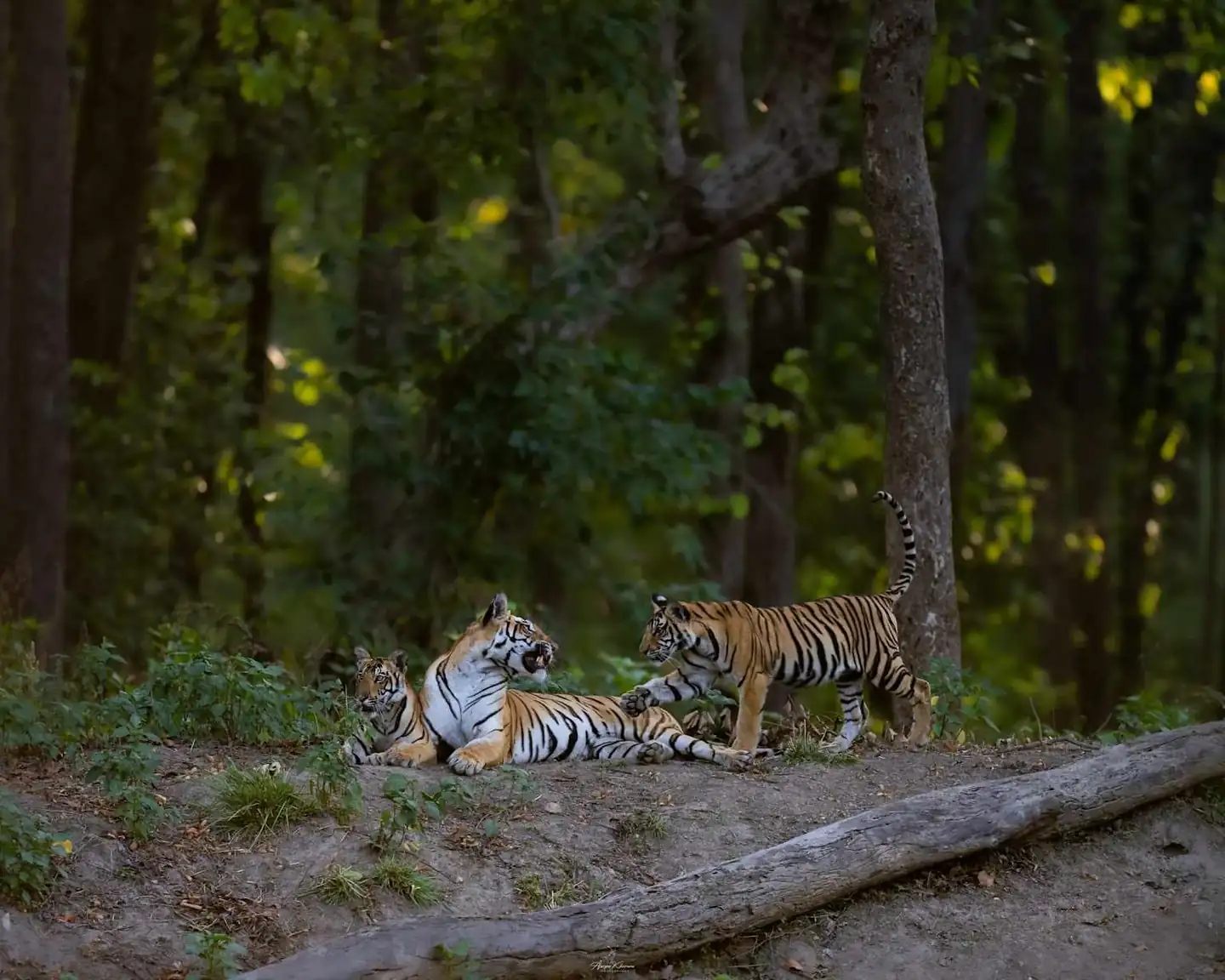
Nagzira Wildlife Sanctuary — the Green Oasis of Vidarbha.
Bamboo thickets, dry deciduous forest and two shimmering lakes inside Navegaon-Nagzira Tiger Reserve — three quiet core gates, 166+ bird species, and the forest that produced tiger Jai.
On this page
- Nagzira at a glance
- Understanding NNTR
- Why Nagzira deserves attention
- Safari gates & locations
- Gate & stay selection guide
- Booking process
- Timings & season
- Wildlife
- Key attractions
- Nisarga Anubhava & citizen surveys
- Tiger translocation
- How to reach
- Where to stay
- Best time to visit
- Combine with other reserves
- Visitor guidelines
- FAQs
Nagzira and NNTR at a glance — key facts
There is a reason wildlife photographers who have exhausted Tadoba and Pench keep returning to Nagzira. It is not the tiger numbers. It is the silence.
Nagzira Wildlife Sanctuary — now part of the larger Navegaon-Nagzira Tiger Reserve — is one of central India's least crowded and most rewarding wildlife destinations. Spread across bamboo thickets, dry deciduous forest and two lakes in the Bhandara and Gondia districts of Maharashtra, the sanctuary has earned its nickname honestly: the Green Oasis of Vidarbha. This is also the forest that produced Jai — the tiger who walked 130 kilometres to Umred Karhandla and became India's most famous big cat before vanishing without trace.
- Sanctuary name
- Nagzira Wildlife Sanctuary
- Part of
- Navegaon-Nagzira Tiger Reserve (NNTR)
- Tiger reserve status
- 12 December 2013 — India's 46th
- Maharashtra rank
- 5th tiger reserve in the state
- Nagzira area
- 152 sq km
- Total NNTR area
- ~655 sq km
- Districts
- Bhandara & Gondia, Maharashtra
- Nickname
- Green Oasis of Vidarbha
- Open season
- 1 October – 30 June
- Closed
- 1 July – 30 September (monsoon)
- Mammals
- 34 species
- Birds
- 166+ species
- Reptiles
- 36 species
- Core safari gates
- Chorkhamara, Pitezari, Mangezari
Understanding NNTR — five protected areas, one reserve
Visitors frequently ask whether Nagzira is a sanctuary or a tiger reserve. Both are correct. Nagzira Wildlife Sanctuary is one of five protected areas amalgamated into Navegaon-Nagzira Tiger Reserve when it was notified as India's 46th tiger reserve on 12 December 2013.
- Nawegaon National Park
- Nawegaon Wildlife Sanctuary
- Nagzira Wildlife Sanctuary
- New Nagzira Wildlife Sanctuary
- Koka Wildlife Sanctuary
Strategically, NNTR sits at the heart of the central Indian tiger landscape — a region that contributes roughly one-sixth of India's entire tiger population. Almost every major floral and faunal species found in central India occurs here.
Why Nagzira deserves your attention
Genuine solitude. While Tadoba runs dozens of vehicles per shift and Corbett's Dhikala permits sell out in hours, Nagzira remains extraordinarily quiet. On many drives you will encounter almost no other vehicles.
The birthplace of Jai. The legendary tiger Jai — who walked over 130 kilometres to Umred Karhandla and became India's most photographed and later most mourned tiger — was born in these forests.
A critical wildlife corridor. NNTR connects Pench and Kanha, making it ecologically essential to central India's tiger population. Animals genuinely move through this landscape.
Active tiger translocation. Tigress NT2 has been sighted with three cubs, NT3 has been released and re-collared, and further releases are planned. Chital have also been translocated from Tadoba to strengthen the prey base.
Two lakes, exceptional birdlife. With 166+ recorded bird species and two significant waterbodies — including the majestic Sarus Crane — Nagzira is a serious birding destination.
Unique public participation. NNTR runs the Nisarga Anubhava Machan Census, Bird Surveys and Butterfly Surveys open to citizen participants. Almost no other Indian tiger reserve offers this level of public engagement.
Safari gates and exact locations
Nagzira operates several safari gates across the NNTR landscape. Distances from Nagpur vary considerably and — critically — Nagpur is not the practical base for most Nagzira safaris.
Chorkhamara Core Zone (Gates 1 & 2)
100 km from NagpurChorkhamara is Nagzira's most popular safari zone and the closest core gate to Nagpur. Dense forest and hilly country produce consistently good opportunities for tiger, leopard and sloth bear alongside excellent birdlife. The zone operates through two entry points — Chorkhamara Gate 1 and Gate 2.
- Distance from Nagpur
- 100 km
- Drive time
- ~2.5 hours
- Zone type
- Core
- Terrain
- Dense forest, hilly
- Wildlife
- Tiger, leopard, sloth bear, birds
- Best for
- First-time visitors, tiger sightings
Pitezari Core Zone
10 km from SakoliPitezari encompasses Navegaon Lake and its surrounding forest, making it the finest birdwatching zone in the entire NNTR landscape. Migratory species arrive in numbers through winter, and deer, langur and other wildlife are seen regularly. Critical planning advantage: the gate is just 10 km from Sakoli town, which turns an exhausting pre-dawn drive into a fifteen-minute journey.
- Distance from Nagpur
- 115 km
- Distance from Sakoli
- 10 km
- Drive time
- ~2.75 hours from Nagpur
- Zone type
- Core
- Highlight
- Navegaon Lake
- Best for
- Birdwatching, photography, lake wildlife
Mangezari Core Zone
31 km from GondiaMangezari sits on the Gondia side of the reserve and is the most remote of Nagzira's core gates. It sees the fewest vehicles and offers the most secluded safari experience available at NNTR — ideal for repeat visitors and photographers approaching from Gondia or on a wider eastern Vidarbha itinerary.
- Distance from Nagpur
- 125 km
- Distance from Gondia
- 31 km
- Drive time
- ~3 hours from Nagpur
- Zone type
- Core
- Crowd level
- Lowest in NNTR
- Best for
- Seclusion, repeat visitors, photographers
Spot booking gates in NNTR
Beyond the main core gates, NNTR operates several eco-tourism gates where spot booking is available — a significant advantage for last-minute travellers.
| Zone | Gate | Booking |
|---|---|---|
| Nawegaon Bandh Zone | Bakki Gate | Spot booking |
| Pitambartola Zone | Pitambartola Gate | Spot booking |
| Umarzari Zone | Umarzari Gate | Spot booking |
Additional entry gates
The wider NNTR landscape operates multiple entry points across its constituent protected areas, including Nagzira, Kosamtondi, Murpar, Murdoli, Balapur and Pongezara. Murdoli was recently inaugurated as a new tourism entrance gate, expanding access to previously under-visited forest.
Gate selection guide — which gate and where to stay
This is where most Nagzira trips succeed or fail. The single most common mistake visitors make is basing themselves in Nagpur — 100 km from the nearest gate, which means departing around 3:30 AM in darkness on rural roads. The solution is simple: base yourself locally.
| If you stay at | Best gate | Distance |
|---|---|---|
| Sakoli ⭐ | Pitezari | 10 km |
| Gondia | Mangezari | 31 km |
| Bhandara | Chorkhamara | ~40 km |
| Nagpur (not advised) | Chorkhamara | 100 km |
| Your priority | Recommended gate |
|---|---|
| First visit, tiger focus | Chorkhamara |
| Birdwatching | Pitezari (Navegaon Lake) |
| Maximum solitude | Mangezari |
| Last-minute booking | Bakki, Pitambartola or Umarzari (spot booking) |
| Coming from Gondia | Mangezari |
| Coming from Nagpur | Chorkhamara |
Our recommendation: stay two nights at Sakoli and do four safaris across Pitezari and Chorkhamara. You get both the lake birdlife and the dense-forest tiger habitat, without a single pre-dawn long-distance drive.
Safari booking process
NNTR safari permits are issued by the Maharashtra Forest Department through the official reserve website (nawegaonnagzira.com) and the state booking portal (safaribooking.mahaforest.gov.in). Numerous private agency websites use similar names and appear prominently in search results — verify you are on a .gov.in domain before making payment.
Entry permit timings
| Season | Permit issue hours |
|---|---|
| October – January | 7:00 AM – 6:00 PM |
| February – June | 7:00 AM – 7:00 PM |
Booking rules
- Permits are issued in the traveller's name and are non-transferable
- Fake passes or permits in another person's name are not accepted and may attract heavy fines
- Original photo identification must be carried during the safari
- Vehicle numbers are limited per zone per shift
- Spot booking is available only at designated eco-tourism gates
Documents required
Indian nationals may present Aadhaar, Voter ID, PAN Card or Driving Licence. Foreign nationals must carry a passport. Original documents are mandatory at the entry gate.
Safari timings and season
NNTR is open to visitors from 1 October to 30 June, and closes entirely for tourism from 1 July to 30 September during the monsoon.
Safaris operate in two daily shifts — morning and evening — with timings shifting seasonally in line with sunrise and sunset. Morning safaris consistently produce better mammal sightings, particularly during summer months.
Wildlife of Nagzira
NNTR supports 34 mammal species, 36 reptile species and over 166 bird species across its varied habitats.
Predators
- Tiger — resident population strengthened by ongoing translocation
- Leopard — regularly sighted across all zones
- Dhole (Indian wild dog) — pack sightings occur
- Sloth bear — common, particularly in hilly terrain
- Jungle cat — grassland edges
Herbivores
- Indian gaur (bison) — impressive herds
- Sambar, chital and nilgai — abundant throughout
- Barking deer — forest edges
- Mouse deer — one of India's smallest and most elusive ungulates
- Wild boar — common
Birds — 166+ species
Nagzira's two lakes make it a serious birding destination. The Sarus Crane — the world's tallest flying bird — is among the sanctuary's most celebrated residents. Around the lakes, herons, egrets, kingfishers and storks are consistently present, and winter brings migratory species in significant numbers. NNTR runs an annual Citizen Bird Survey each January and celebrates Bird Week from 5–12 November.
Butterflies and reptiles
NNTR conducts an annual Butterfly Survey, with the Plumbeous Silverline recorded here for the first time. Crocodiles are occasionally seen basking along the shores of Nagzira Lake, and thirty-six reptile species have been recorded across the reserve.
Key attractions within Nagzira
Nagzira Lake — the sanctuary's central feature and a vital water source for wildlife. Early mornings and late afternoons offer the best sightings, with migratory birds along the shores and occasional crocodile sightings.
Navegaon Lake (Pitezari zone) — a scenic waterbody and prime birdwatching location, with herons, egrets, kingfishers and storks frequently sighted. The peaceful surroundings make it excellent for photography.
Dr. Salim Ali Bird Sanctuary — located within Navegaon National Park, approximately 50 km away. Essential for serious birders.
Itiadoh Dam — 65 km from Nagzira, offering birdwatching, boating and a peaceful retreat.
Nisarga Anubhava and citizen surveys
This is where NNTR genuinely stands apart from every other Indian tiger reserve.
Nisarga Anubhava — the Machan Census
Held on Buddha Purnima each year, Nisarga Anubhava invites members of the public to spend an entire night on forest machans (raised platforms) conducting a wildlife census. Participants sit through the night beside waterholes, recording every animal that arrives — one of the most immersive wildlife experiences available anywhere in India, and open to ordinary citizens through an application process. Applications are invited annually and shortlisted participants are announced on the official NNTR website.
Citizen Bird Survey
Conducted each January, this multi-day survey invites birdwatchers to participate in structured data collection across the reserve. Participants receive certificates and contribute to genuine conservation science.
Butterfly Survey & waterbird census
The Butterfly Survey is held annually in September, with approximately 50 applications invited, and has produced new species records for the reserve. NNTR also participates in the international Asian Waterbird Census with public registration opportunities. For serious naturalists, timing a Nagzira visit around one of these events transforms a safari trip into genuine participation in conservation.
Tiger translocation at NNTR
NNTR is running one of India's most closely watched tiger translocation programmes. Tigers have been relocated here to establish a viable breeding population in a landscape that historically supported tigers but had seen numbers decline. Tigress NT2 has been photographed with three cubs — a significant conservation milestone indicating successful establishment. Tigress NT3 was released, subsequently re-collared, and continues to be monitored closely.
Further tiger releases are planned. In parallel, 34 chital were translocated from Tadoba into Navegaon Bandh National Park to strengthen the prey base — a necessary foundation for a growing predator population. For visitors, this means Nagzira's tiger population is actively growing rather than static.
How to reach Nagzira
By air: Dr. Babasaheb Ambedkar International Airport, Nagpur is the nearest airport — Chorkhamara gate is 100 km away, approximately 2.5 hours by road.
By train: Gondia Junction is the most convenient railway station for Mangezari gate at 31 km, and Bhandara Road station also serves the region well. Gondia sits on the Howrah–Mumbai main line with good national connectivity.
| From | To Chorkhamara | To Pitezari | To Mangezari |
|---|---|---|---|
| Nagpur | 100 km | 115 km | 125 km |
| Sakoli | ~25 km | 10 km | ~40 km |
| Gondia | ~50 km | ~40 km | 31 km |
| Bhandara | ~40 km | ~35 km | ~60 km |
Distances to other reserves
| Reserve | Distance |
|---|---|
| Umred Karhandla | 50 km |
| Navegaon National Park | 50 km |
| Tadoba | ~100 km |
| Pench | 120 km |
| Kanha | 160 km |
Where to stay near Nagzira
Accommodation near Nagzira is limited compared to Tadoba, but the options that exist are well positioned.
- Sakoli — the single best base, just 10 km from Pitezari gate, with basic to mid-range accommodation and no long pre-dawn drives
- Gondia — a larger town with more hotel options, 31 km from Mangezari gate and ideal for visitors arriving by train
- Bhandara — several hotels, reasonably positioned for Chorkhamara gate
- Nagpur — the most comfortable accommodation but genuinely impractical for morning safaris given the 100+ km distance
- Forest Department rest houses — limited availability; advance enquiry is essential
Planning note: facilities near the gates are minimal. Carry water and food for your safari, and plan meals around your accommodation.
Best time to visit Nagzira
November to February — best overall. Comfortable temperatures, excellent birdlife including migratory arrivals and pleasant safari conditions. Bird Week runs 5–12 November and the Citizen Bird Survey takes place each January.
March to June — best for mammal sightings. As waterholes shrink, wildlife concentrates around the lakes and remaining water sources, and thinning vegetation improves visibility. Nisarga Anubhava, the Machan Census, falls on Buddha Purnima in this period — typically May. Temperatures are high but morning and evening safaris remain manageable.
October — post-monsoon green. The reserve reopens into spectacular greenery. Sightings are less predictable with abundant water and dense vegetation, but the landscape is at its most beautiful and crowds are minimal.
July to September — closed. NNTR shuts entirely for tourism during the monsoon.
Combining Nagzira with other reserves
- Nagzira + Umred Karhandla (3N/4D) — just 50 km apart; tranquil forest paired with open-grassland tiger sightings
- Nagzira + Tadoba (4N/5D) — approximately 100 km apart; high tiger density paired with genuine solitude
- Eastern Vidarbha Circuit (5N/6D) — Nagzira, Navegaon National Park, Umred Karhandla and Tadoba in one journey
- Nagzira + Kanha (5N/6D) — 160 km apart, connecting Maharashtra's corridor forest with Madhya Pradesh's flagship reserve
Essential visitor guidelines
Rules
- Carry original photo ID matching your permit
- Fake or transferred permits attract heavy fines
- Maintain complete silence during safari
- Never alight from the vehicle
- No feeding or approaching wildlife
- Carry all waste out of the reserve
- Follow guide instructions at all times
What to carry
- Original identification for all passengers
- Binoculars — essential given the birdlife
- Camera with telephoto lens
- Neutral clothing — olive, khaki, brown
- Water and food (limited facilities near gates)
- Warm layers for winter mornings
- Sunscreen and a hat for summer
Frequently asked questions — Nagzira safari
How far is Nagzira from Nagpur?+
Distance depends on the gate. Chorkhamara core gate is 100 km from Nagpur, Pitezari is 115 km and Mangezari is 125 km. However, Nagpur is not the practical base — Pitezari gate is just 10 km from Sakoli town, and Mangezari is 31 km from Gondia.
Which gate is best for tiger sighting at Nagzira?+
Chorkhamara core zone is the most popular and productive gate, with dense forest and hilly terrain favouring tiger, leopard and sloth bear sightings. Pitezari is superior for birdwatching around Navegaon Lake, while Mangezari offers the most secluded experience.
Is Nagzira the same as Navegaon Nagzira Tiger Reserve?+
Nagzira Wildlife Sanctuary is one of five protected areas that together form Navegaon-Nagzira Tiger Reserve, notified as India's 46th tiger reserve on 12 December 2013. The others are Nawegaon National Park, Nawegaon Wildlife Sanctuary, New Nagzira Wildlife Sanctuary and Koka Wildlife Sanctuary.
Where should I stay for a Nagzira safari?+
Sakoli is the best base — just 10 km from Pitezari gate. Gondia works well for Mangezari gate at 31 km. Bhandara is reasonable for Chorkhamara. Staying in Nagpur means a 100+ km pre-dawn drive and is not recommended.
When is Nagzira open?+
NNTR is open from 1 October to 30 June. The reserve closes completely for tourism from 1 July to 30 September during the monsoon season.
Can I book a Nagzira safari on the spot?+
Yes, at designated eco-tourism gates. Spot booking is available at Bakki Gate (Nawegaon Bandh Zone), Pitambartola Gate (Pitambartola Zone) and Umarzari Gate (Umarzari Zone). Core zone gates should be booked online in advance.
What is Nisarga Anubhava at Nagzira?+
Nisarga Anubhava is NNTR's Machan Census, held annually on Buddha Purnima. Members of the public spend an entire night on forest platforms beside waterholes recording wildlife. Applications are invited each year and shortlisted participants are announced on the official NNTR website. Very few Indian tiger reserves offer public participation of this kind.
How many tigers are there in Nagzira?+
NNTR is running an active tiger translocation programme rather than reporting a static count. Tigress NT2 has been sighted with three cubs and NT3 has been released and re-collared, with further releases planned. Chital have also been translocated from Tadoba to strengthen the prey base.
Is Nagzira good for birdwatching?+
Exceptionally. Over 166 bird species have been recorded, including the Sarus Crane. The Pitezari zone around Navegaon Lake is the prime birding area. NNTR runs an annual Citizen Bird Survey each January and celebrates Bird Week from 5–12 November.
Was tiger Jai from Nagzira?+
Yes. Jai — who became India's most famous tiger after walking over 130 km to Umred Karhandla, and who disappeared without trace in 2016 — was born in Nagzira. His story begins in these forests.
What is the entry permit timing at Nagzira?+
Entry permits are issued from 7:00 AM to 6:00 PM between October and January, and from 7:00 AM to 7:00 PM between February and June.
Can I combine Nagzira with Tadoba or Umred Karhandla?+
Easily. Umred Karhandla is 50 km away and Tadoba approximately 100 km. Many visitors combine Nagzira's solitude with Tadoba's higher tiger density and UPKWS's open-grassland sightings in a single eastern Vidarbha itinerary.
Ready to plan your wildlife journey?
Share your dates and preferences — our specialists reply within a working day with permits, gypsies and resort options bundled into one clear itinerary.
Offices · Bhopal (HO) · Delhi
Continue exploring
Umred Pauni Karhandla
Just 50 km away — tiger Jai's adopted home, three gates and rare wildlife.
Read more →Tadoba Andhari Tiger Reserve
All 26 gates with map links, booking process and famous tigers.
Read more →Pench (Maharashtra)
Sillari, Khursapar and Chorbahuli — an easy Vidarbha pairing.
Read more →Bor Tiger Reserve
A compact reserve in the same connected landscape near Nagpur.
Read more →Kanha Tiger Reserve
160 km away — the corridor forest at the other end of NNTR.
Read more →All Tiger Reserves
Kanha, Bandhavgarh, Pench, Satpura, Panna and more.
Read more →